Bidirectional charging australia: Save on energy with V2G & V2H
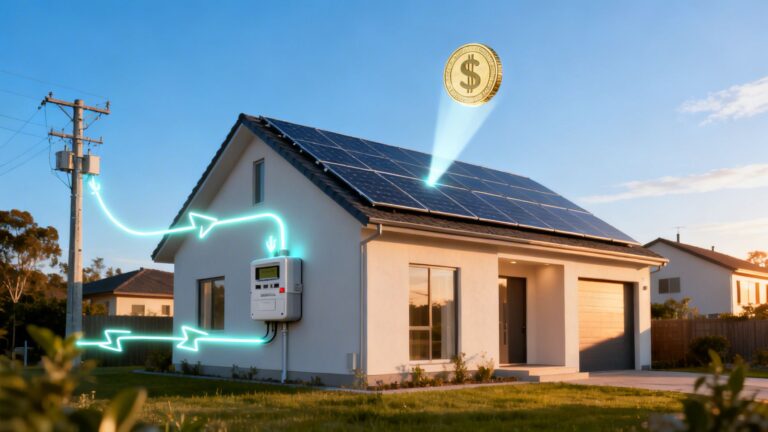
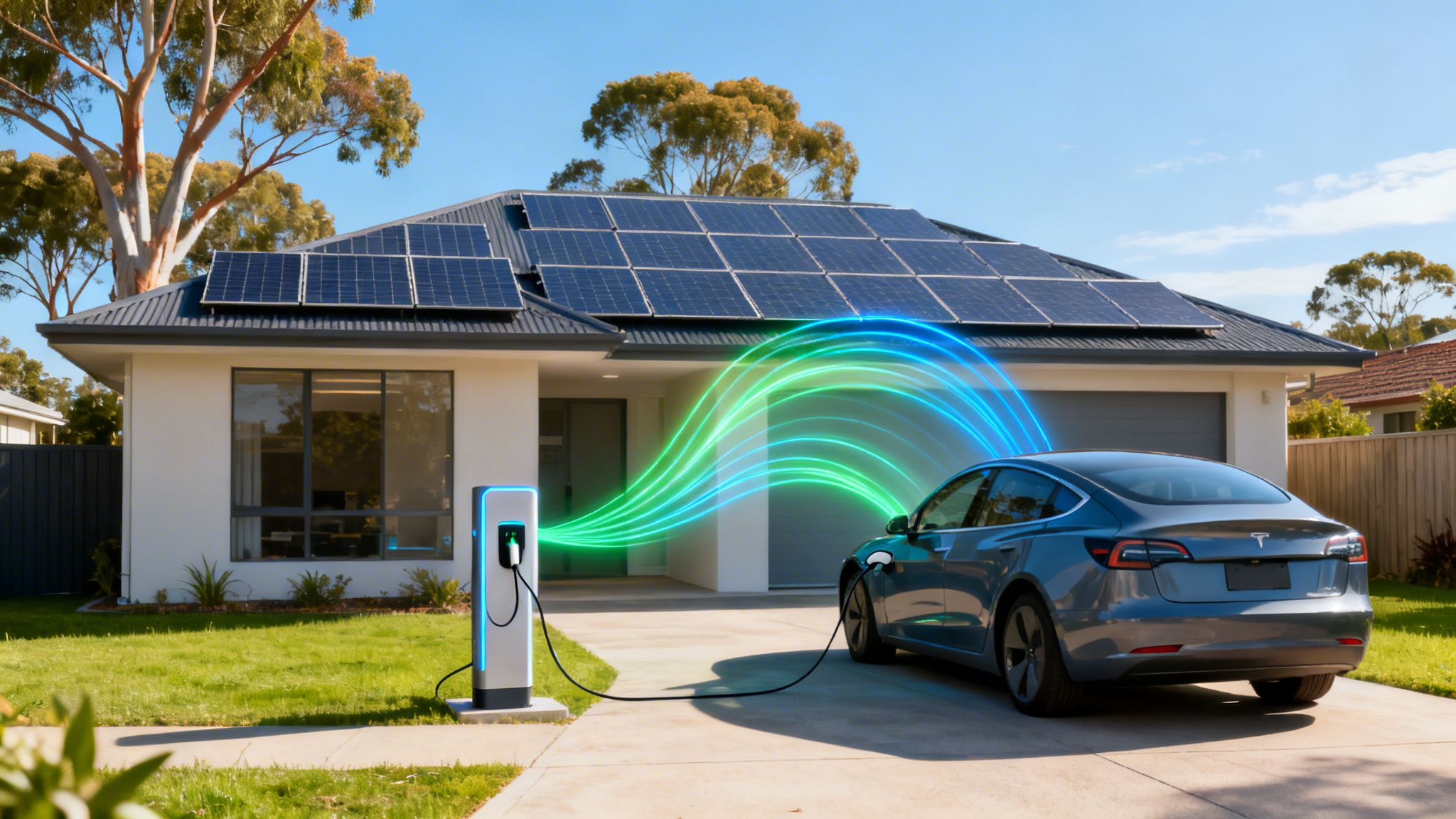
Imagine your electric vehicle as more than just a way to get from A to B. What if it was also a two-way energy hub parked right in your driveway?
Bidirectional charging in Australia makes this a reality. It allows electricity to flow from your EV's battery back into your home or even to the grid. This simple shift turns your car from just another appliance into an active player in your home's energy ecosystem.
How Bidirectional Charging Transforms Your EV
Most of us think of our EV as something that just consumes power. A standard charger reinforces this idea—it’s a one-way street, pushing electricity from your solar panels or the grid straight into your car. It's a simple, but limited, relationship.
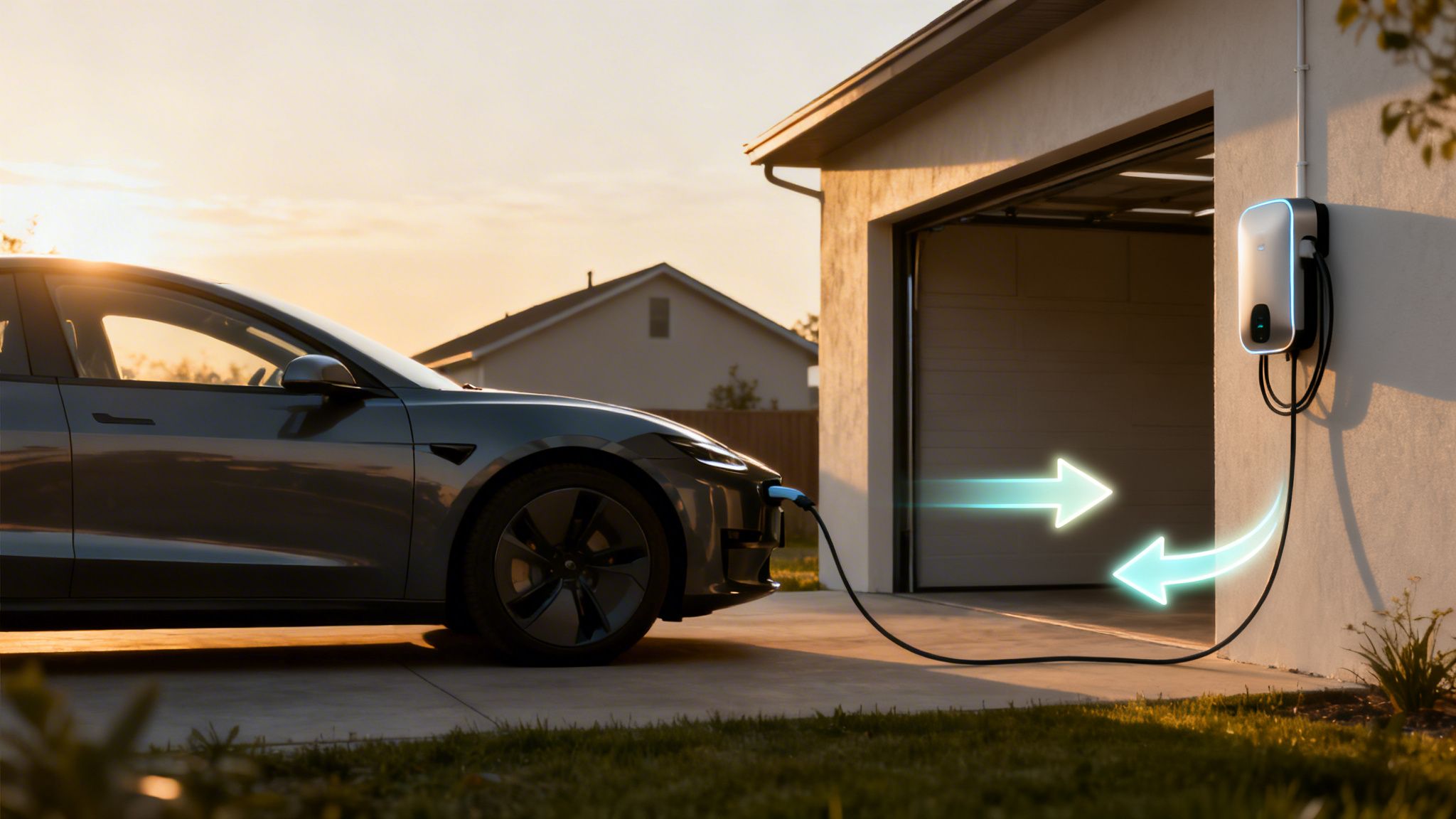
Bidirectional charging completely flips that on its head. It creates a two-way superhighway for electricity, letting your EV both take a charge and send power back out. This powerful capability effectively turns your car into a large, mobile battery you can use to interact with your home and the grid.
This isn't just a minor tech upgrade. It's a fundamental change in how we can manage energy at home. Instead of being a passive consumer, you become an active participant, deciding when to store, use, or even sell the energy stored in your vehicle. It’s about turning a depreciating asset—your car—into a smart part of your energy independence.
Vehicle-to-Home (V2H) Power on Demand
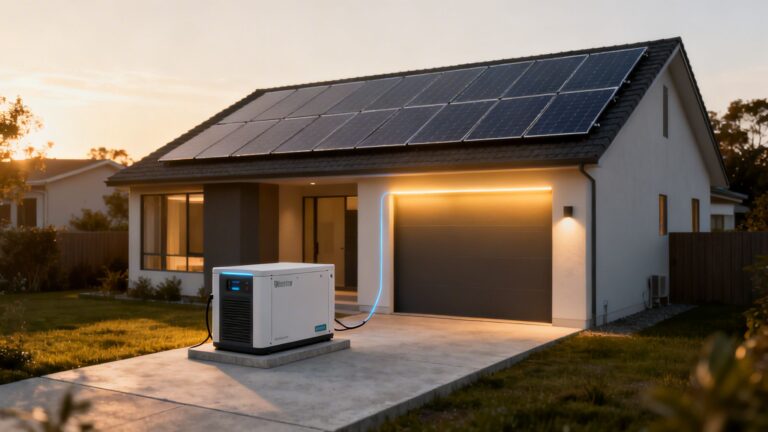
The most practical and immediate application of this technology is Vehicle-to-Home (V2H). The easiest way to think about it is having a personal power station on wheels, ready to support your home whenever you need it.
With V2H, the energy stored in your car’s battery can run your entire house. During a blackout, this means your lights stay on, the fridge keeps running, and essential appliances are good to go—all without the noise, fumes, and hassle of a diesel generator.
But it goes well beyond emergencies. V2H is a seriously clever way to manage your power bills. Here’s a typical scenario:
- Charge with Solar: During the day, you fill up your EV’s battery with free, clean energy from your solar panels.
- Power Your Home at Night: Instead of buying expensive electricity from the grid during the evening peak, your home simply draws power from your car.
- Avoid Peak Tariffs: This strategy lets you sidestep the highest electricity rates, which can dramatically cut your bills and get more value out of every drop of solar you produce.
With V2H, you're effectively creating a buffer against grid instability and skyrocketing energy prices. The car you drive to work becomes a key part of your home’s energy resilience.
Vehicle-to-Grid (V2G) Supporting the Broader Network
Vehicle-to-Grid (V2G) takes this idea one giant step further. Instead of just powering your own home, V2G allows you to send stored energy from your EV all the way back to the public electricity grid. Your car is no longer just an asset for you, but for the entire energy network.
V2G technology opens the door to participating in grid-support programs, often run by energy retailers. Think about those scorching summer afternoons when everyone’s air conditioner is blasting and the grid is under immense strain. With a V2G system, you can sell your stored energy back to the grid at a premium, creating a brand new income stream.
This whole process is typically automated through smart software, so it only ever exports power when it’s most profitable for you and won't leave you short for your morning commute. Choosing the right system is crucial, and the first step is understanding what’s involved with home charging setups. For a deeper dive, check out our guide on choosing the best home EV charger.
By participating in V2G, you're not just earning extra revenue. You’re actively helping to stabilise the grid and support Australia’s shift towards a renewable energy future.
The 2026 Outlook For Bidirectional Charging In Australia
For years, bidirectional charging felt like a concept on the distant horizon. Now, the future is arriving much faster than we thought. Bidirectional charging in Australia is finally shifting from small-scale trials to a tangible reality for savvy homeowners.
The year 2026 is shaping up to be a real turning point. This is when the technology stops being a niche experiment and starts becoming a mainstream upgrade for your home energy system.
This isn't just wishful thinking; the groundwork has been laid. A huge milestone was the approval of the first Clean Energy Council (CEC) certified bidirectional chargers. This certification is critical—it standardises the hardware to meet Australia’s tough safety and performance rules, giving the green light for home installations right across the country, including NSW.
What was once a confusing puzzle of incompatible tech and regulatory grey areas is now becoming a clear path for early adopters.
From Trial Programs To Commercial Rollouts
The momentum is undeniable. Both government and private companies are pushing forward. Vehicle-to-Grid (V2G) technology is now recognised as a core part of Australia's energy future, with big trials graduating to real-world rollouts.
The Australian Renewable Energy Agency (ARENA) and Race for 2030 have even commissioned a national roadmap. The goal? To have bidirectional charging services widely available by 2030, backed by federal government planning. Some analysts are predicting uptake could mirror the success of solar PV, potentially leading to 2.6 million residential V2G systems by 2040.
This progress is creating some exciting new models for homeowners. One of the most interesting is Origin Energy's subscription service, set to launch in 2026. It bundles a compatible EV with a certified bidirectional charger, showing how energy retailers are creating consumer-friendly packages to get things moving.
For homeowners in NSW with an existing solar setup, this is where the opportunity really comes into focus. You can finally connect the dots between your solar generation, energy storage, and transport.
What This Means For NSW Homeowners
The national progress on bidirectional charging directly translates to local advantages for residents in Sydney and greater NSW. With our established solar infrastructure and clearer regulatory pathways, you're perfectly positioned to be an early adopter.
Here’s what the 2026 outlook really lets you do:
- Maximise Solar Self-Consumption: Instead of exporting your excess solar for tiny credits, store that clean energy directly in your EV’s battery during the day.
- Achieve Peak-Time Independence: Use that stored solar energy to power your home during the expensive evening peak, slashing your reliance on the grid when it costs the most.
- Participate in Grid Services: As V2G programs expand, your EV can become an active part of the energy market, earning you money by supporting the grid during high-demand events.
By embracing bidirectional charging now, you aren't just installing a new piece of hardware. You're future-proofing your home against rising electricity costs and building genuine energy resilience.
This convergence of technology, regulation, and market readiness creates a powerful incentive. The ability to integrate your car into your home's energy strategy is no longer a pipe dream.
Partnering with an experienced installer like Interactive Solar ensures you can navigate this new landscape with confidence, from picking the right certified gear to managing grid connection approvals in NSW. By acting now, you can lead the charge in creating a smarter, more self-sufficient home. This is deeply connected to the idea of community energy sharing, which you can learn more about in our deep dive into Virtual Power Plants in Australia.
Your Essential Bidirectional Charging Checklist
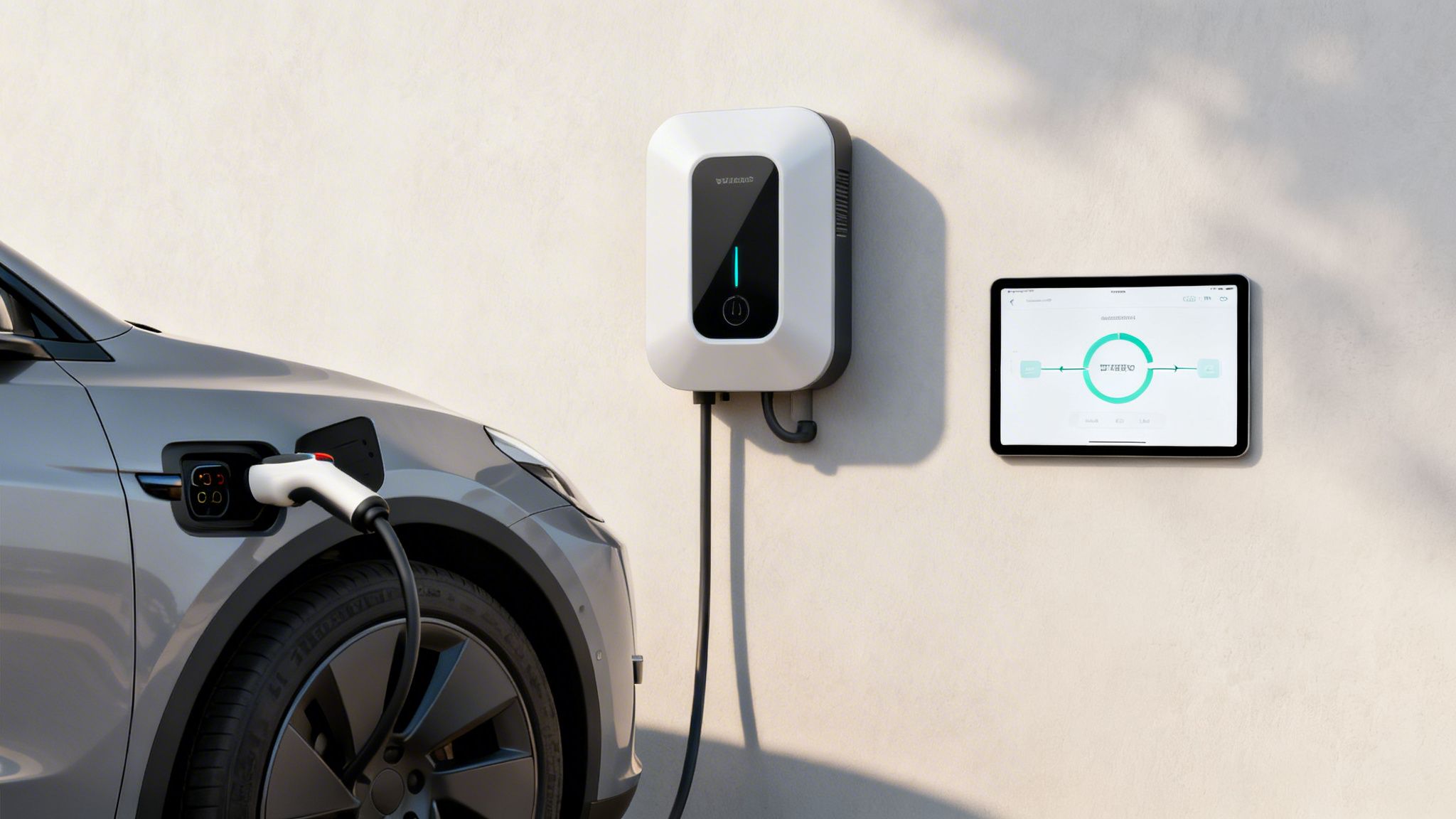
So, you’re thinking about turning your EV into a power source for your home or business. That’s great. The technology is finally catching up with the idea, and setting up a system is more achievable than ever before.
But it’s not as simple as swapping out your old charger. A true bidirectional system needs every part to communicate and work together perfectly. Think of it as a three-legged stool—if one leg is missing, the whole thing topples over.
Getting these three core components right from the start is the key. It’s what separates a seamless, money-saving energy system from a frustrating and expensive headache.
1. A Bidirectional-Ready Electric Vehicle
This is the first, and often biggest, hurdle. Not all EVs are built the same, and the ability to send power out of the battery is a specific feature that has to be included by the manufacturer from day one.
Your EV needs to support either the CHAdeMO charging standard or the newer CCS2 standard with bidirectional capability enabled. For years, cars like the Nissan Leaf (which uses CHAdeMO) were the only real players in this space. Now, thankfully, more carmakers are building V2G-ready models using the CCS2 plug, which is the standard across Australia.
The critical thing to remember is that this isn't a software update or an aftermarket add-on. The capability has to be built into the car's hardware at the factory. We keep a close eye on all the latest EV releases, so we can point you toward models that will actually work with a V2H or V2G system.
An EV with bidirectional capability is fundamentally different from a standard electric car. It's designed not just to store energy for driving, but to act as an active component of a larger energy ecosystem, similar to a high-capacity battery on wheels.
2. A Certified Bidirectional Charger
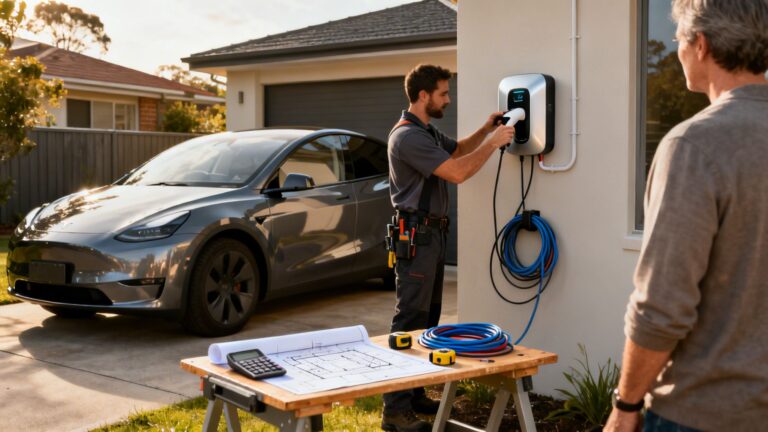
Next up is the charger itself. A bidirectional charger is a much smarter and more complex piece of kit than the one-way charger you might be used to. It contains an inverter, which is the crucial component that converts the DC power stored in your car's battery back into the AC power your home and the grid use.
Here in Australia, any bidirectional charger must be certified by the Clean Energy Council (CEC) and, just as importantly, approved for connection by your local electricity network. This isn't just red tape; it's a critical process that ensures the charger is safe, reliable, and won’t cause problems for the grid.
This device is the heart of your setup, managing the two-way energy flow between your car and your property. That's why we only work with certified, top-tier chargers that are proven to be safe, compliant, and built for the long haul. If you're weighing up your options, our detailed battery comparison guide is a great resource for understanding how different storage solutions perform.
3. Intelligent Management Software
The final piece of the puzzle is the software—the brains behind the whole operation. This smart control system coordinates the entire dance, telling your system when to charge, when to discharge, and where the power should go.
This is where the magic really happens. With the right software, you can automate everything to:
- Charge your EV using only your spare solar power, so you're not paying for grid electricity.
- Power your home from the car's battery during expensive peak tariff times, slashing your bills.
- Sell power back to the grid when demand is high, earning you credits or even direct payments.
This software is what makes the system truly "set and forget." It works silently in the background to hit your goals, whether that's maximum savings, reliable backup power, or making money from the grid. At Interactive Solar, we make sure the hardware and software are perfectly integrated to give you a seamless experience.
Bidirectional Charging Compatibility Checklist
To make sense of it all, here's a quick-reference table outlining what you need to get a functional bidirectional charging system up and running at your home or business.
| Component | Key Requirement | Interactive Solar's Role |
|---|---|---|
| Electric Vehicle (EV) | Must be factory-built with bidirectional capability (V2G/V2H). Supports a compatible charging standard (CHAdeMO or V2G-enabled CCS2). | We advise you on which EV models currently available in Australia are compatible and meet the technical standards for bidirectional charging. |
| Bidirectional Charger | Must be specifically designed for two-way power flow. Needs to be certified by the Clean Energy Council (CEC) and approved for connection by your local network distributor. | We supply and install only fully compliant, CEC-approved bidirectional chargers from trusted manufacturers, ensuring safety and network compliance. |
| Management Software | An intelligent control platform that automates charging and discharging based on your solar generation, home usage, grid prices, and personal preferences. | We configure and integrate the smart management software to perfectly align with your hardware and optimise your system for your specific goals. |
| Grid Connection | Requires formal approval from your electricity network operator (e.g., Ausgrid, Endeavour Energy) before the system can be legally connected and operated to export power. | We handle the entire grid connection application process on your behalf, managing the paperwork and technical submissions to ensure a smooth approval. |
Putting these pieces together correctly is the difference between a system that works and one that doesn't. By understanding each component's role, you're already on the right track to making an informed decision about your energy future.
Unlock The Financial And Lifestyle Benefits
Beyond the cool tech, the real magic of bidirectional charging is what it does for your wallet and your lifestyle. It’s about turning your EV from something that just sits in the driveway into a hard-working home energy asset. This completely changes the game, moving your car from a simple transport tool to a core part of your family's financial and energy plan.
The financial upside is immediate and genuinely powerful. By tapping into your EV's battery, you can completely change how you use and pay for electricity, leading to some serious savings and even new ways to earn money.
Slash Your Electricity Bills With V2H
The most straightforward win comes from Vehicle-to-Home (V2H). Picture this simple daily routine: your solar panels top up your EV battery for free all day. Then, when the sun goes down and power prices shoot up, your home automatically starts running on the cheap, clean energy you’ve stored in your car.
This strategy, known as "solar time-shifting," lets you dodge the most expensive grid electricity every single evening.
- Avoid Peak Tariffs: You’ll drastically cut how much power you buy from the grid during those costly peak demand hours.
- Maximise Solar Value: Instead of getting pennies for exporting your excess solar, you store every last kilowatt-hour in your car to use when it's most valuable.
- Reduce Grid Reliance: Your dependence on the grid plummets, protecting your budget from surprise price hikes and market chaos.
For the average household, this can make a huge dent in your quarterly electricity bills. You're not just buying less power; you're using your own stored energy when it saves you the most money.
Create A New Revenue Stream With V2G
Vehicle-to-Grid (V2G) takes things a step further. It turns your EV into a mini-power plant that can actually earn you money. Energy retailers across Australia are rolling out programs that pay you to send stored power back to the grid when it's needed most.
Think of a scorching summer afternoon when the grid is groaning under the strain. Your V2G system could automatically sell a small chunk of your EV’s battery power back at a premium, creating a new income source out of thin air. One groundbreaking V2G trial in rural NSW saw a participant earn incredible revenue in just two hours by selling power during an outage. Over a whole year, he powered his home, drove 26,000 km, and still ended up with a credit on his power bill.
When you consider how quickly electric cars depreciate, these financial benefits really start to stack up. The ability for an EV to generate income helps offset its running costs and makes the whole proposition much more attractive.
Gain True Energy Independence And Security
The perks of bidirectional charging go way beyond your bank account. They offer a level of energy freedom and security that was pretty much impossible for most homeowners until now. Your EV battery is massive—far larger than a typical home battery—giving you a huge reservoir of backup power.
During a blackout, a V2H system can keep your home running for days, not just a few hours. This means:
- Uninterrupted Comfort: The lights stay on, the fridge keeps running, and you still have internet and air conditioning.
- Peace of Mind: You get a reliable backup power source without the noise, fuel, or fumes of a diesel generator.
- Total Self-Sufficiency: Pair it with solar, and you can ride out extended outages completely off-grid, recharging your car and powering your home with nothing but sunlight.
This creates a powerful sense of resilience. You're no longer at the mercy of grid failures or planned maintenance. You’re in control of your own power supply, ensuring your family stays safe and comfortable no matter what’s happening on the network. This isn't just about saving money; it’s about gaining real security and a smarter way to live.
Create The Ultimate Home Energy Ecosystem
This is where all the individual pieces click into place. By weaving bidirectional charging into your existing solar panels and home battery, you’re not just getting another gadget. You’re building a complete, self-reliant home energy ecosystem. It’s the way these three technologies work together that really unlocks their full potential.
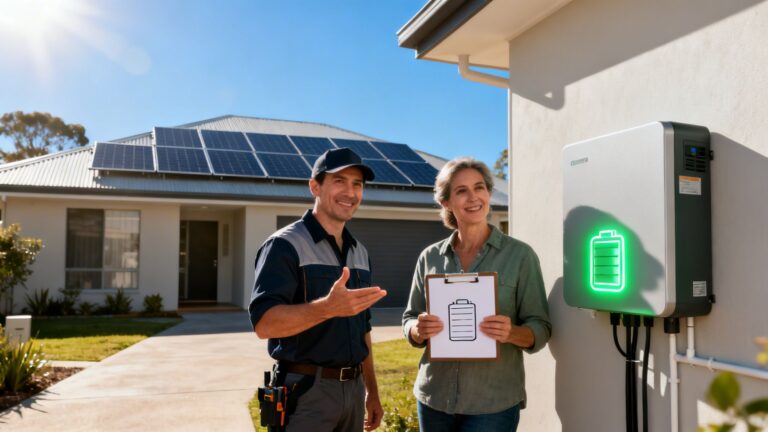
Think of it like a team where each player has a specific job. Your solar panels are the star generators, cranking out free energy whenever the sun is out. Your home battery, like the one in a Tesla Powerwall 3 system, acts as a rapid-response defender, covering your immediate power needs and keeping the lights on. Then, your EV’s massive battery becomes your ultimate energy reservoir—a huge storage tank ready to be called upon when you need it most.
This setup lets you capture, store, and intelligently use virtually every kilowatt-hour your solar panels produce. It dramatically cuts your reliance on the grid and frees you from the pain of rock-bottom solar feed-in tariffs.
Synergy in Action: A Daily Cycle
Let’s walk through how this integrated system works on a typical day.
- Morning: The sun comes up, and your solar panels start generating power. This energy first covers your home's morning needs—the coffee machine, toaster, and lights.
- Midday: As solar production hits its peak, it quickly fills your smaller home battery. Once that’s full, all the leftover solar power is channelled straight into your EV's large battery, charging it for free.
- Evening: The sun goes down, and solar generation stops. Instead of buying expensive electricity from the grid during peak evening hours, your home automatically starts drawing power from your dedicated home battery.
- Night: Once the home battery is empty, the system seamlessly switches over to pulling power from your EV's much larger battery. This stored solar energy can easily run your home through the night and into the next morning, all without buying a single kilowatt-hour from the grid.
This smart, automated cycle means you are always using your own clean, free energy first. It puts you in total control, boosting your return on investment and making sure you get the absolute most value out of your entire solar system.
Future-Proofing Your Home and Investment
Pulling these technologies together isn’t just about saving money today; it’s about getting ready for the future. As Australia's energy market keeps changing, having a flexible and powerful home energy system becomes a huge asset. You’re no longer just a passive consumer—you become an active player in the energy grid.
This infographic breaks down the core benefits of combining solar, batteries, and bidirectional charging.
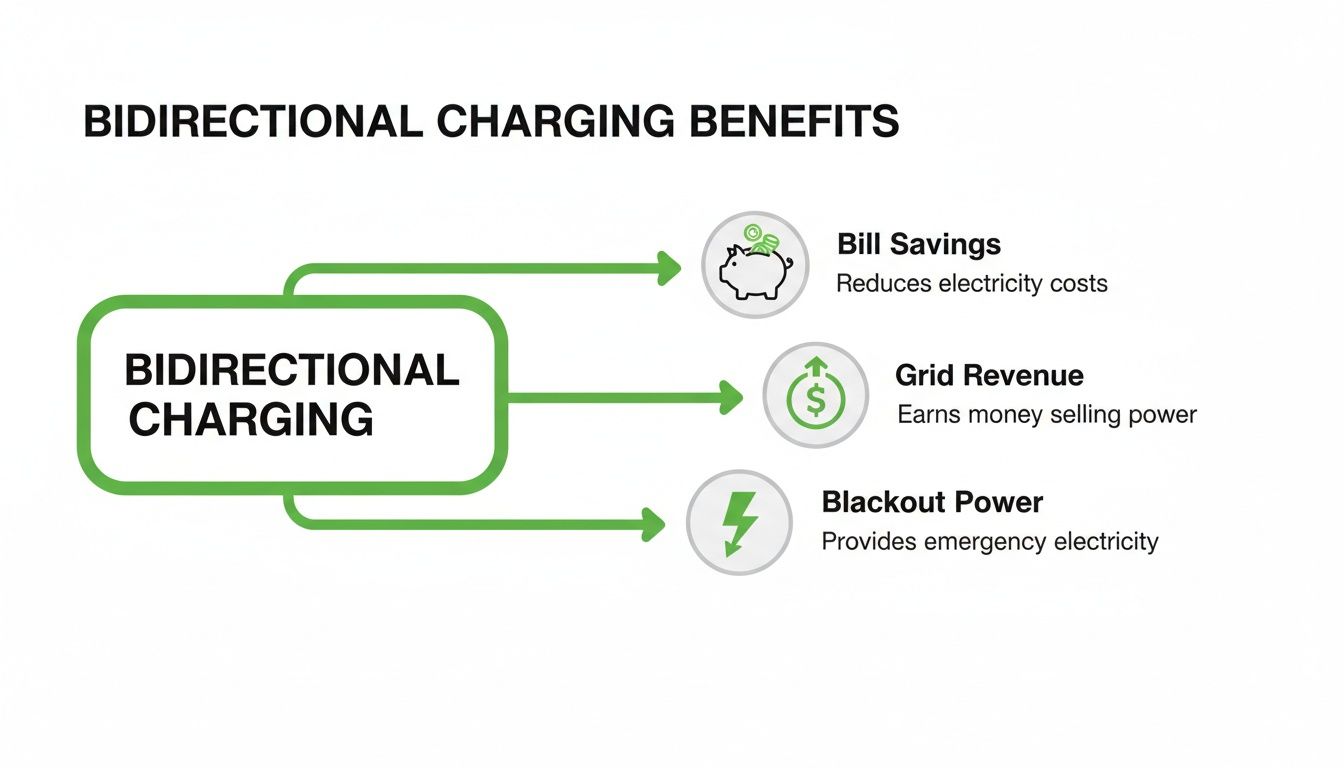
As you can see, the technology delivers real-world outcomes like lower bills, the potential for grid earnings, and security during blackouts, turning your home into a proper energy hub.
Our national infrastructure is also catching up fast to support this shift. For example, Australia’s public EV charging network saw significant growth of about 20% between 2024 and 2025. This was helped along by a federal government commitment of AU$40 million to roll out an additional 10,000 public charging points, creating an even stronger ecosystem for EV owners.
Our expertise is in designing and installing these fully integrated systems. We make sure every component—from the solar panels on your roof to the bidirectional charger in your garage—works in perfect harmony. As you plan your energy ecosystem, you might also want to look into how to incorporate sustainable home designs building for the future to maximise long-term benefits and create a truly resilient home.
Answering Your Bidirectional Charging Questions
As you start looking into bidirectional charging, it’s completely normal to have questions. This technology is a big step up from a standard EV charger, and getting your head around the details is the key to making a confident decision. We hear from homeowners across NSW all the time who are curious about the real-world side of things, from battery health to the fine print in local regulations.
This section is all about giving you direct, clear answers to those common queries. Our goal is to cut through the jargon and give you the practical information you need. By tackling your concerns head-on, we hope to replace any uncertainty with clarity and show you that we're here to empower you with knowledge.
Will Using V2G or V2H Degrade My EV Battery Faster?
This is a really smart and common question. The short answer is that any time you charge or discharge a battery, it goes through a tiny amount of wear. However, bidirectional charging systems are specifically designed to be incredibly gentle on your EV’s battery.
Think of it like this: aggressive, fast-paced driving and constant rapid DC charging are like sprinting—they put a lot of stress on the battery. V2H and V2G, on the other hand, are more like a slow, steady walk. They use slow, shallow discharge cycles, which are far less stressful for the battery's chemistry.
Modern bidirectional systems are built with battery longevity in mind. The intelligent software makes sure it only operates within a safe state-of-charge "window"—for example, never letting the battery drop below 30% or discharge too quickly.
On top of that, vehicle manufacturers are increasingly factoring this gentle use into their battery warranties. As experts in this field, we can guide you to a system setup that puts the long-term health of your vehicle first, ensuring you get the most out of your investment for years to come.
What Is The Difference Between V2L, V2H, and V2G?
It’s helpful to think of these as three different levels of power-sharing capability, each with its own job. Understanding the distinction helps clarify what you can actually do with bidirectional technology.
Vehicle-to-Load (V2L): This is the most basic form. It lets you plug standard electrical appliances directly into your car, much like a portable generator. It’s perfect for powering a laptop, tools on a worksite, or even a coffee machine while you're camping.
Vehicle-to-Home (V2H): This is a major leap forward. V2H technology connects your car to your home’s switchboard and lets you power the entire house. It’s the ultimate backup during a blackout and the key to slashing your power bills by using stored solar energy at night.
Vehicle-to-Grid (V2G): This is the most advanced level. V2G creates a two-way conversation between your EV and the public electricity grid. It allows you to not only power your home but also to sell your stored energy back to the grid, helping to stabilise the network and creating a new income stream for you.
At Interactive Solar, we specialise in designing and installing the fully integrated V2H and V2G systems that deliver true energy independence and financial benefits.
Is Bidirectional Charging Approved For Use In NSW?
Yes, the path for installing bidirectional chargers in NSW is now clear. As of 2026, Clean Energy Council (CEC) approved bidirectional chargers are available for installation in Australian homes, and the necessary standards for connecting them to local electricity networks are in place.
However, it's not a simple plug-and-play deal. Any bidirectional system has to go through a formal application and get approval from your local electricity distributor, like Ausgrid or Endeavour Energy here in NSW. This process ensures the system is safe, compliant, and won't cause problems for the local grid.
As fully licensed and experienced installers, we manage this entire complex process for you. We handle all the technical submissions and paperwork, navigating the network requirements to make sure your system is fully compliant, safe, and officially approved from start to finish.
If you have more specific questions about compliance or anything else, feel free to explore our detailed resources. You might be interested in reading through our frequently asked questions for more expert insights.
How Do I Get Started With a Bidirectional Charging System?
The easiest and most effective way to begin is simply with a conversation. The first step is to get in touch with our team for an expert, no-obligation consultation.
We’ll start by listening to what you want to achieve—whether that’s blackout protection, lower bills, or earning a bit of money from the grid. We’ll look at your current energy usage, your property, and your driving habits.
From there, we design a complete, tailored solution that includes:
- Guidance on a compatible EV model.
- The ideal CEC-approved bidirectional charger for your needs.
- Seamless integration with any existing or new solar and battery setup.
We handle every single step of the journey, from the initial system design and network applications to the final certified installation and commissioning. Our goal is to make your path to energy independence as simple and stress-free as possible.
Ready to transform your EV into a powerful home energy asset? The team at Interactive Solar has the expertise to design and install a seamless bidirectional charging system tailored to your home and lifestyle. Take control of your power bills and future-proof your home today by visiting us at https://interactivesolar.com.au.