

The Price Of A Tesla Powerwall: Costs & Savings
Last updated:
Another large power bill lands in your inbox. You start searching the price of a tesla powerwall, and within a few minutes you’ve seen half a dozen different figures, a few overseas articles, and a stack of online calculators that all pretend the answer is simple.
It isn’t.
In Sydney, a Powerwall isn’t a boxed appliance you pull off a shelf. It’s part of a complete electrical project that has to work with your switchboard, your existing solar, your roof layout, your backup goals, and local compliance requirements. That’s why the number people see online is often only the start, not the final figure that matters.
What Is the True Cost of a Tesla Powerwall in 2026
A Sydney homeowner might see one Powerwall price online, call for a quote, and then wonder why the installed figure is higher. In real projects, the battery is only one part of the spend. The final cost depends on how the Powerwall has to be integrated into the home, what electrical work is required, and whether the existing solar and switchboard are ready for it.
That is why a generic figure has limited value. It can help with rough research, but it does not tell you what the project will cost at your address.
Recent price changes have also made older articles less useful. Battery pricing has shifted over time, Tesla product updates have changed system configurations, and installer supply costs have moved with the market. A number from a forum thread or a blog post from a year or two ago can send you in the wrong direction before anyone has looked at your site.
Unit price versus project price
The battery-only number is a starting reference. Budgeting for a real installation requires the full scope around it.
On a Sydney job, that can include mounting hardware, gateway or control equipment, protection devices, cabling, labour, commissioning, and any switchboard work needed to bring the system up to current standards. Backup configuration also affects the price. Some homeowners want basic battery storage for evening use. Others want selected circuits backed up during outages, which changes the design and the labour involved.
I tell clients to treat online pricing as a loose guide only. If no one has asked about your switchboard, your current inverter setup, your cable run, or your backup goals, the number is incomplete.
If you are still weighing up battery options, our battery comparison guide for Sydney homeowners is a useful place to start.
Why Sydney homes vary so much
No two homes are priced the same for long. A newer home with a clean switchboard, easy access, and a battery location close to the main board is usually more straightforward. An older property can need extra circuit work, a board upgrade, longer cable runs, or a more complex integration with existing solar equipment.
Even homes on the same street can land at different installed prices.
The only figure worth relying on is a site-specific quote based on the home, the existing electrical setup, and the level of backup and bill reduction the owner wants. That is the number that reflects the true cost of a Tesla Powerwall project in 2026.
Understanding Your Total Powerwall Project Investment
When people ask about the price of a tesla powerwall, they usually mean one number. In practice, there are several layers to that number.
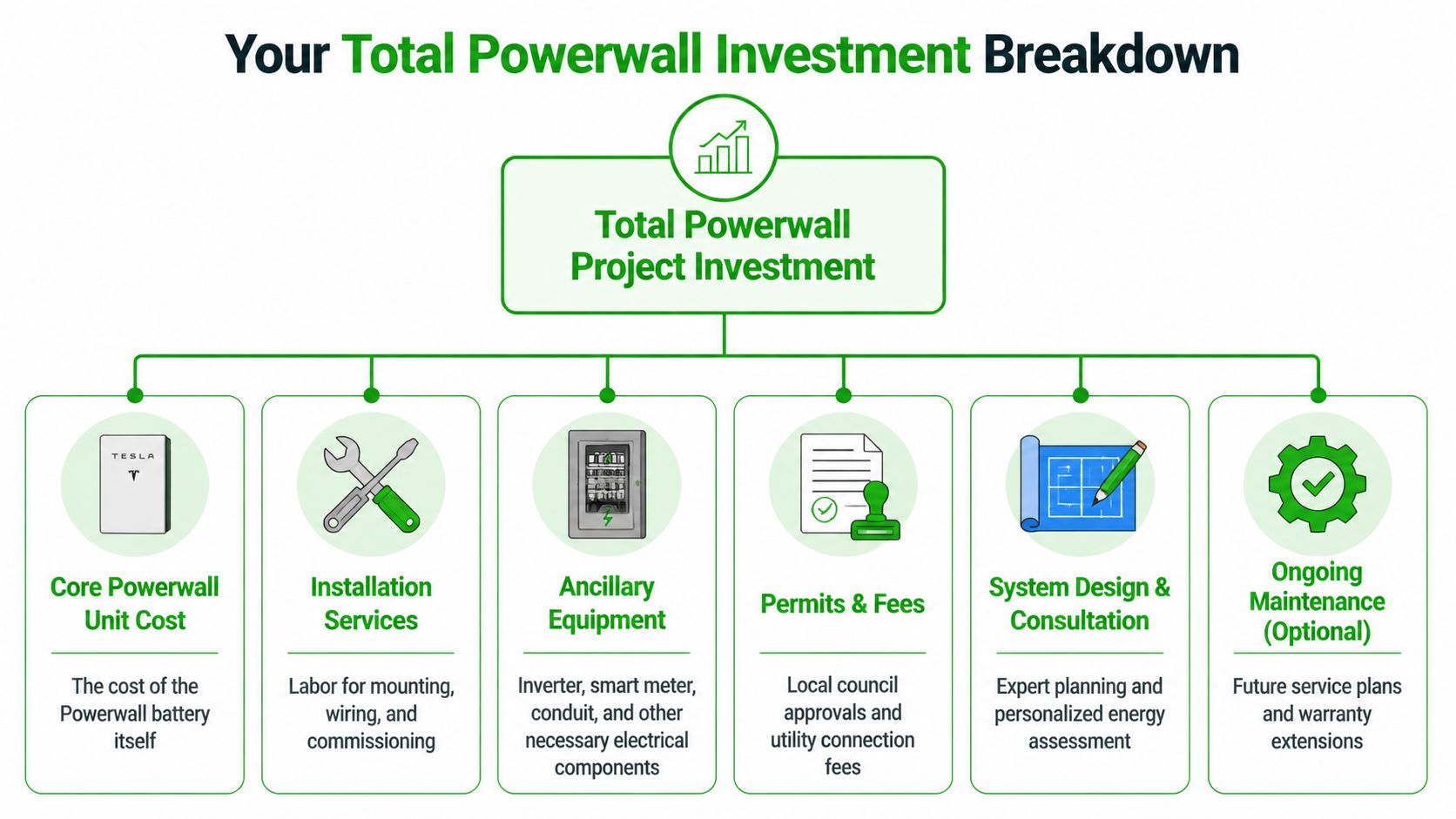
The cleanest way to think about it is to separate the core hardware from the project delivery costs. The battery itself matters, but so do the surrounding components and the work required to make the whole system operate safely and legally in NSW.
The battery is only one line item
A Powerwall installation usually starts with the battery unit and then expands into everything needed around it.
The broad breakdown often looks like this:
- Battery hardware. This is the Powerwall itself.
- Installation labour. Mounting, wiring, testing, and commissioning all require qualified trades.
- Ancillary equipment. Projects can require items such as gateway hardware, protection devices, metering, conduit, isolators, and other electrical components.
- Switchboard work. Some homes need upgrades before the battery can be integrated safely.
- Compliance and grid connection. Certification, testing, and approval steps are not optional.
A lot of online estimates ignore those final four items, which is why they often look attractive but don’t survive a real site inspection.
Why the installed figure climbs
One of the clearest data points on this comes from battery installation cost breakdowns reviewed by Solar.com’s explanation of Tesla Powerwall installation pricing. It notes that ancillary components and certified labour can represent 45–54% of the total project cost. That’s a huge reason a battery-only figure rarely matches the final installed amount.
Here’s a simple way to view it:
| Cost area | What it covers | Why it changes from home to home |
|---|---|---|
| Core battery | The Powerwall unit | Product supply and current market pricing |
| Labour | Mounting, wiring, commissioning | Access, wall type, cable distance, site complexity |
| Ancillary components | Gateway, electrical gear, integration hardware | Existing system compatibility and backup design |
| Switchboard work | Upgrades and reconfiguration | Age of board, available space, compliance issues |
| Approvals and testing | Grid connection, certification, final checks | Retailer and network requirements |
The hidden costs aren’t really hidden
They’re just rarely explained properly.
If you’ve already got solar, the installer has to check whether your current setup can work cleanly with a Powerwall project. If the switchboard is dated, crowded, or non-compliant, that gets addressed first. If the cable run from the chosen battery location back to the board is long or awkward, labour and materials rise.
That’s why comparing battery products on unit cost alone gives an incomplete picture. A better starting point is a broader battery technology and design comparison such as this battery comparison guide for Australian buyers, then narrowing the choice based on site conditions.
A cheap-looking battery quote can become an expensive project once real electrical work is added. A transparent quote shows those items upfront.
What works and what doesn’t
What works is a quote that lists the major project elements clearly and explains which costs are fixed versus site-dependent.
What doesn’t work is relying on an overseas article, a battery-only price, or a calculator that assumes every Sydney home has the same switchboard, the same solar setup, and the same backup needs.
Key Factors That Influence Your Installation Quote
A Sydney homeowner sees an online Powerwall price, adds a rough install allowance, and assumes they’re close. Then the site inspection happens. The switchboard needs work, the cable route is longer than expected, and the backup plan is broader than “keep the fridge on.” The battery price did not change. The project scope did.
That is why a generic Powerwall figure is often misleading. The true cost comes from the electrical work around the battery, not just the battery itself. I would rather be direct about that than give a neat number that falls apart once the job is properly assessed.

Your switchboard sets the tone for the job
This is often the biggest variable in older Sydney homes.
If the board is modern, clearly labelled, and has room for the required protection gear, the install is usually more straightforward. If it is crowded, outdated, or has signs of piecemeal additions over time, the battery project can trigger upgrade work before the Powerwall is even connected. That adds labour, parts, and sometimes a wider board reconfiguration to bring the installation up to standard.
This is common in Federation homes, post-war stock, and houses that have been renovated in stages. On a sales brochure, the property may look ready for battery storage. On site, the switchboard often tells a different story.
Existing solar can reduce cost, or create extra scope
A home with solar already installed is not automatically a simple battery add-on.
The installer has to check what equipment is there, how it has been wired, whether it suits the proposed Powerwall design, and whether any changes are needed to get clean integration and reliable backup operation. Some systems slot in neatly. Others need extra work because the original solar setup was designed only for daytime export savings, not battery charging, backup circuits, or future expansion.
That difference matters. Two homes can both “have solar” and still end up with very different Powerwall quotes.
Battery location affects labour more than people expect
Homeowners usually start with the preferred wall. We start with compliance, service access, cable path, heat exposure, and how neatly the job can be finished.
A close mounting position near the switchboard or point of connection usually keeps labour and materials under better control. A location that requires long cable runs, difficult penetrations, work through finished spaces, or awkward access pushes the project cost up. Wall construction matters too. Brick, rendered masonry, limited clearance, or tight side access all affect install time.
The cheapest-looking position is not always the right one. The right one is the position that can be installed safely, serviced properly, and integrated cleanly with the rest of the system.
Backup design changes the quote quickly
“Backup” is one of the most misunderstood parts of a battery quote.
Some households want outage protection for lighting, refrigeration, internet, and a few selected circuits. Others want a much broader backup arrangement and expect large parts of the home to keep operating during a blackout. Those are different electrical designs with different hardware, circuit planning, and commissioning requirements.
Customized quotations are essential. If one quote assumes limited backup and another assumes a broader backup scope, the cheaper figure is not a fair comparison.
Site access still affects real installation cost
Labour is not just about electrical complexity. It is also about how hard the site is to work on.
Common cost drivers include:
- Restricted access. Narrow side paths, stairs, split-level layouts, or limited working room slow handling and installation.
- Distance across the property. Detached garages, rear-lot homes, and long cable routes add time and materials.
- Building surfaces and penetrations. Some walls and service paths are slower to work with than others.
- Coordination on occupied sites. Homes with strict access windows or business premises with operating constraints require more planning.
Good workmanship shows up in the finish, the cable management, the testing, and how serviceable the system is years later. That is covered well in this guide to installation quality and long-term system value.
Current supply pricing matters, but site conditions matter more
Battery pricing does move over time, as noted earlier. But day to day, the bigger cause of quote variation across Sydney homes is site-specific electrical scope.
A real quote should account for the house you own. Your board condition, your solar setup, your backup expectations, your access constraints, and the standard of installation you want all affect the final figure. That is why the only accurate answer is a customized quote based on an inspection, not a battery-only price pulled from a calculator.
Sizing Your System for Energy Independence
The number of Powerwall units you need has a bigger impact on the project than almost anything else.
This isn’t just a budget decision. It’s a design decision tied to how you live, when you use power, how large your solar system is, and what “energy independence” means in your household.
Start with behaviour, not just bills
A power bill gives part of the story. It doesn’t show enough on its own.
Two homes can spend a similar amount on electricity and still need very different battery setups. One family might use most of its energy after sunset. Another might consume heavily in the late afternoon, run air conditioning hard in summer, or have weekend-heavy demand patterns.
That’s why good battery sizing looks at questions like these:
- When do you use the most power. Evening-heavy usage usually pushes battery value up.
- How much solar do you already have. The battery needs enough daytime generation behind it to charge well.
- What do you want during outages. Basic resilience and broad backup support are not the same target.
- Are your loads changing soon. An EV, pool equipment, induction cooking, or home office expansion can shift the design.
One battery now or room to grow later
Powerwall’s modular design is useful because it gives households options. According to EnergySage’s Powerwall review, up to 4 units can be connected for a total of 54 kWh of storage. That scalability matters if your current needs are moderate but likely to grow.
Some homeowners are best served by starting with one unit and reviewing performance after they’ve lived with the system through summer and winter. Others already know their usage profile is too large for that approach and prefer to size for the end goal from day one.
A battery should match the way the home operates, not the way the quote calculator assumes it operates.
A simple way to think about sizing
This framework is more useful than chasing a generic number:
| Household goal | Typical design thinking |
|---|---|
| Lower evening grid use | Focus on storing daytime solar for night-time consumption |
| Better blackout protection | Prioritise backup circuits and realistic outage expectations |
| High self-sufficiency | Match battery size carefully to solar production and usage profile |
| Future EV charging | Allow for growing overnight demand and possible later expansion |
A larger battery bank can support more loads and more overnight use. It also costs more, and it only performs well if the solar side is sized appropriately. Storage without enough generation behind it often disappoints.
For homeowners also planning solar or reviewing array size, this NSW solar panel cost guide helps frame the solar side of the equation.
What works in practice
What works is setting a clear priority before the design starts. Lower bills, outage protection, and maximum grid independence are related goals, but they aren’t identical.
What doesn’t work is picking a battery count purely because a neighbour chose it, or because one online article suggested a “standard” setup. There isn’t one.
Unlocking Savings with NSW Rebates and Incentives
The headline price of a battery project isn't always the amount you pay.
For NSW households, federal incentive settings can reduce the upfront outlay, and that changes the conversation from “Can I justify this?” to “How do I structure this properly?” The key is understanding how the support works and making sure it’s applied correctly in the quote.

How the federal scheme affects battery cost
In Australia, federal incentives like the Small-scale Renewable Energy Scheme can significantly reduce the upfront cost of a home battery, and in NSW the creation of Small-scale Technology Certificates can lower the final installed price depending on system size and location, as outlined in SolarReviews’ overview of Tesla Powerwall and Australian incentives.
For homeowners, the important practical point is this. These incentives are usually factored into the quote and applied as an upfront reduction, rather than arriving later as a simple cash rebate in your bank account.
Why your postcode and system design matter
Many generic articles fall short.
Certificate creation depends on the details of the project, and those details can vary by location and system configuration. That means two homes can both be in NSW and still end up with different effective pricing once incentives are applied.
That’s also why broad internet answers to the price of a tesla powerwall often confuse people. They might mention a product price but ignore the local incentive mechanics that affect what the homeowner sees on the final proposal.
Savings aren’t only upfront
The value case can come from more than the initial discount.
A battery can help by:
- Increasing solar self-consumption. More of your own generation stays in the home instead of being used by the grid first.
- Reducing exposure to evening tariffs. Stored energy can be used when imported electricity is less attractive.
- Opening the door to VPP participation. Some households can add an income stream on top of bill management.
If you’re sorting through what support may apply locally, this NSW battery rebate guide is a useful place to start.
Rebates help, but they don’t fix a poor design. The best result is still a system that suits the property and the household.
What to ask before comparing quotes
Not every proposal presents incentives the same way. A clean quote should show whether the discount has already been applied and what assumptions sit behind it.
Use this checklist:
- Ask how incentives are handled. Find out whether the quote is showing gross cost, net cost, or both.
- Confirm site assumptions. Rebate outcomes depend on the actual system design, not just the product name.
- Check what is included. A lower net figure can still hide excluded electrical works.
- Look at the whole proposal. The right quote balances incentive value with proper installation scope.
The best battery quote isn’t the one with the smallest headline number. It’s the one that explains the final out-of-pocket position clearly and transparently.
Calculating Your Return on Investment
A Powerwall makes more sense when you stop treating it like a gadget purchase and start treating it like an energy asset.
The return comes from a mix of avoided grid purchases, smarter use of your own solar, and in some cases extra earnings. The exact payback depends on your usage pattern, your tariff structure, your solar performance, and how the battery is configured.
The first lever is self-consumption
Without a battery, a lot of solar generation happens when the home doesn’t need it most. That means the house can still buy electricity later in the day even though it generated energy earlier.
A battery changes that by shifting solar into the evening. In practical terms, you’re keeping more of your own power for your own use. Homes that use a lot of electricity after sunset often see the strongest value from this.
The second lever is tariff timing
Not all imported electricity costs the same at all times. In homes with time-based pricing, battery storage can help reduce reliance on the periods that hurt most.
That doesn’t mean every tariff automatically makes a battery worthwhile. It means the battery has to be matched to the tariff structure and the household routine. If the home’s biggest demand happens outside solar hours, storage has a clearer role.
Here’s a practical summary:
| Value driver | How it helps |
|---|---|
| Solar self-consumption | Stores daytime generation for later home use |
| Tariff management | Reduces grid purchases at less favourable times |
| Backup value | Adds resilience that some households place high value on |
| VPP participation | Can create an additional revenue stream in some programs |
The third lever is VPP participation
This is often overlooked when people only compare upfront pricing.
Some Australian homeowners can earn hundreds of dollars per year by enrolling their battery in a Virtual Power Plant program, where the network can draw small amounts of stored energy to support the grid during high-demand periods, according to SolarQuotes’ guide to Virtual Power Plants in Australia.
That won’t suit everyone. Some people prioritise maximum control over their own stored energy and prefer not to participate. Others like the extra return and are comfortable with the trade-off.
Backup power has a value that doesn’t always show up neatly in a spreadsheet. For some households, avoiding one bad outage justifies part of the decision on its own.
What a realistic ROI calculation includes
A sensible return calculation should include:
- Your actual load profile. Not just monthly spend, but when the home uses power.
- Your solar production pattern. The battery has to be charged consistently to create value.
- Your tariff details. Flat rates and time-based rates create different outcomes.
- Your blackout concerns. Some buyers are paying partly for resilience, not only savings.
- Your willingness to join a VPP. Optional, but relevant where available.
What doesn’t work is using a one-size-fits-all payback figure copied from a forum or sales ad. Battery economics are site-specific. Good modelling reflects the home you live in, not an average household in another state or another country.
Is a Tesla Powerwall the Right Choice for You
A Tesla Powerwall is a strong fit for some homes and the wrong fit for others.
It tends to suit households that already have solar or are installing solar at the same time, want a polished all-in-one battery experience, care about backup capability, and want a system that can be expanded later if energy needs grow. It also appeals to people who value a clean user experience and want to monitor storage and household energy behaviour through a well-known platform.
When it makes sense
A Powerwall usually makes the most sense when several of these conditions line up:
- You have meaningful evening usage. The battery has regular work to do after solar production drops.
- You want outage support. Backup isn’t an afterthought for your household.
- You’re planning for future electrification. EV charging and higher electric loads can make storage more relevant over time.
- You want one integrated ecosystem. Product simplicity matters to you, not just lowest upfront spend.
When another battery may suit better
Not every homeowner needs what Tesla is best known for.
Some buyers care more about brand ecosystem and app experience. Others care more about chemistry preferences, compatibility with an existing setup, or how a different battery integrates into their broader design. The right answer depends on the house, the energy profile, and the budget.
That’s why the best advice is usually comparative, not brand-first. If you want a deeper look at Tesla’s latest model and how it fits into a home energy plan, this Tesla Powerwall 3 guide is a helpful reference.
A balanced view
Powerwall is well known for good reason. It’s scalable, widely recognised, and often a very capable option for Sydney homes.
But “popular” and “best for your property” are not always the same thing. A battery recommendation should come after the site assessment, not before it. That’s the difference between product selling and proper system design.
Get a Clear Quote for Your Sydney Home
If you’ve been searching the price of a tesla powerwall, the main takeaway is simple. There isn’t one universal number that means much on its own.
The final figure depends on your switchboard, your solar setup, the battery location, your backup requirements, the amount of storage you need, and the incentives available at the time of quoting. That’s why online calculators and generic price lists so often miss the mark.
A useful quote does more than name a product. It shows the full scope of works, explains the design choices, and makes the out-of-pocket cost clear.
If you want a clear, site-specific answer, Interactive Solar can help. Their family-owned NSW team handles consultation, design, certified installation, and after-care, so you get a detailed quote based on your home, your energy goals, and your electrical setup, not a generic estimate pulled from the internet.
Make Interactive Solar a preferred source in Google
One click tells Google to surface our articles more often in Top Stories, AI Overviews and AI Mode.