
Solar Battery Supply and Install: A Complete NSW Guide
Last updated:
You’re probably here because the first stage of solar made sense. Panels cut your daytime power costs, but you still buy expensive electricity in the evening, and outages still leave you exposed unless your system was built for backup. That’s the moment most homeowners start looking at battery storage.
A good battery install isn’t just a box on the wall. It’s a design job, an electrical job, a compliance job, and a long-term support decision. The supply side matters because stock quality, warranty support, inverter compatibility, and installer experience all affect how the system performs years after installation day.
In NSW, the difference between a smooth project and a frustrating one usually comes down to how the installer handles the full journey. Site assessment, switchboard checks, product matching, approvals, commissioning, and aftercare all matter. If one part is rushed, the whole system suffers.
The Case for Energy Storage Beyond Solar Panels
A solar battery works like your personal energy reserve. Your panels generate electricity during the day. Instead of sending all the excess back out, the battery stores it for the time when your household usually needs it most, after sunset, during peak tariff periods, or during an outage if the system includes backup capability.
That’s why storage changes the value of solar. Panels produce energy. A battery gives you more control over when you use it.

In practical terms, homeowners usually want three things from a battery. Lower bills. Less reliance on the grid. Backup power when the network goes down. Those goals overlap, but they don’t always point to the exact same battery design, which is why a proper consultation matters.
Why batteries make sense now
Battery uptake has moved well past early-adopter territory. Australia’s residential solar battery installations hit a record in 2024, with over 57,000 systems installed, and properly sized systems can reduce grid reliance by 70 to 100% according to the IEA PVPS snapshot of global PV markets. That tells you something important. Homeowners aren’t adding storage as a novelty. They’re adding it because the economics and the resilience benefits are now easier to justify.
For many NSW households, the battery is the missing piece in the energy plan. Solar on its own is excellent during the middle of the day. The problem is that most homes don’t use their highest amount of electricity at midday. They use it in the morning and again in the evening when lights, cooking, heating, cooling, and appliances all come on.
Practical rule: If your solar exports a lot during the day and you import a lot after dark, a battery is usually the next conversation worth having.
There’s another angle that doesn’t get enough attention. Grid approvals and interconnection can take time. When delays happen, a battery can still help you use your own solar energy sooner rather than waiting for every final grid step to line up, as noted in the earlier source. That matters when you want the system doing useful work from day one.
If you’re weighing storage as part of a broader plan for how to reduce your home electricity bill, battery storage belongs in the same conversation as load shifting, efficient appliances, and tariff choice.
What homeowners usually value most
Some buyers are focused on savings. Others are thinking about blackouts after bad weather. Others don’t like being fully dependent on the grid when they already have panels on the roof. All of those are valid reasons.
Here’s what a well-designed battery system can do well:
- Shift solar into the evening: Instead of losing useful generation in the afternoon, you hold it for dinner time and overnight essentials.
- Reduce grid purchases: The home draws more of its own stored energy before importing from the network.
- Support backup circuits: If configured correctly, the system can keep selected loads running during an outage.
- Improve self-consumption: More of the energy your roof generates gets used in your home rather than exported.
A battery won’t turn every suburban home into a fully off-grid property. In most cases, that isn’t the right target anyway. The better target is control. Used properly, storage gives you a buffer against tariff pain, network instability, and wasted daytime solar.
For homeowners comparing options, the most useful next step is seeing what today’s battery categories and configurations are like in practical use. A practical overview of current solar battery options for NSW homes helps frame that decision properly.
Designing Your Perfect Solar Battery System
A battery system is usually won or lost before any hardware is mounted. The design stage decides whether the battery will work well with your existing solar, cover the loads you care about, and pay its way over time.
I’ve seen the same problems come up again and again. A battery is oversized for the home’s daytime solar production. Backup is promised without checking which circuits can be supplied. A new battery is matched to older equipment that limits performance or creates avoidable extra costs later. Good design prevents those mistakes.
The first design decision is connection type. The second is sizing. Get those right, and the rest of the project becomes much more straightforward.
AC-coupled or DC-coupled
Homeowners hear these terms early, and they matter because they affect cost, efficiency, flexibility, and how much of the existing system can stay in place.
AC-coupled batteries are often the practical choice for homes that already have solar. The battery is added on the AC side of the system, so an existing solar inverter can often remain if it is compatible and still worth keeping. That usually makes retrofit work simpler and avoids replacing equipment that still has useful life left.
DC-coupled systems are often a better fit for new solar-and-battery installs, or for major upgrades where a hybrid inverter makes sense. The solar array and battery share the same inverter pathway, which reduces conversion losses and can make the whole setup cleaner from a design point of view.
The trade-off is simple. AC coupling usually gives more flexibility in retrofit jobs. DC coupling usually gives a tidier integrated system when you are starting fresh.
| System type | Usually suits | Main advantage | Main trade-off |
|---|---|---|---|
| AC-coupled | Existing solar homes | Easier retrofit path | More conversion steps |
| DC-coupled | New solar plus battery installs | Cleaner integrated design | Less flexible if keeping older hardware |
Neither option is automatically right. The right answer depends on what is already on the wall, how old it is, and whether the homeowner wants the lowest upfront disruption or the cleanest long-term architecture.
Chemistry matters more than brochure language
For residential battery installs, Lithium Iron Phosphate (LFP) is the chemistry many installers prefer to specify. The reason is practical. Homeowners care about stable operation, service life, and thermal behaviour far more than chemistry labels.
Product differences still matter. Some batteries have better app monitoring. Some handle backup changeover better. Some are easier to expand later. Some are backed by support teams that are responsive when a fault appears, and some are not.
That is why design should never stop at the spec sheet.
A battery can look excellent on paper and still be the wrong fit for the house if it does not suit the switchboard layout, inverter setup, or backup goals. That judgement comes from site experience, not brochure copy.
Sizing the battery properly
Battery sizing works like water storage. Too little capacity and the home runs out of stored energy before the evening peak is over. Too much capacity and part of the battery sits underused because the solar system cannot fill it often enough.
The starting point is not the total quarterly bill. It is the load profile of the house. An installer needs to know when power is used, what runs overnight, how much spare solar is available after daytime loads, and whether the goal is bill reduction, blackout protection, or a balance of both.
A few questions usually shape the right system size:
- When do the heaviest loads run, during the day or after sunset?
- How much surplus solar is available to charge a battery on a normal day?
- Do you want the battery cycling daily for savings, or sitting partly reserved for backup?
- Which loads need support in an outage?
That last point changes the design more than many homeowners expect. Whole-home backup is possible in some properties, but it is not always the best use of budget. Air conditioning, ovens, pool pumps, and EV chargers can push backup requirements up very quickly. In many homes, backing up refrigeration, lights, internet, garage access, and a few general power circuits gives a better result for a much lower cost.
If you are comparing options, this battery comparison guide for NSW households is a useful way to review storage size, backup capability, and compatibility differences side by side.
A quick visual explainer helps clarify how battery design choices affect daily use:
What good design conversations sound like
A proper design discussion gets specific quickly. The installer should ask about your current inverter, switchboard capacity, tariff type, overnight loads, future plans such as an EV or pool heater, and whether anyone in the home needs backup power for work or medical equipment.
Clear limits should also be discussed early. If the existing setup only supports essential-load backup without switchboard upgrades, that should be stated plainly. If a larger battery will spend much of the year half-used, that should be stated too.
That honesty is part of a professional supply-and-install service. The goal is not to sell the biggest battery. The goal is to specify a system that charges properly, discharges when it should, integrates cleanly with the home, and can be supported properly after handover.
The Professional Installation Journey From Start to Finish
You approve a battery expecting lower bills and reliable backup. A few weeks later, the app is confusing, backup only powers half of what you expected, and nobody has explained why. That outcome usually starts long before installation day.
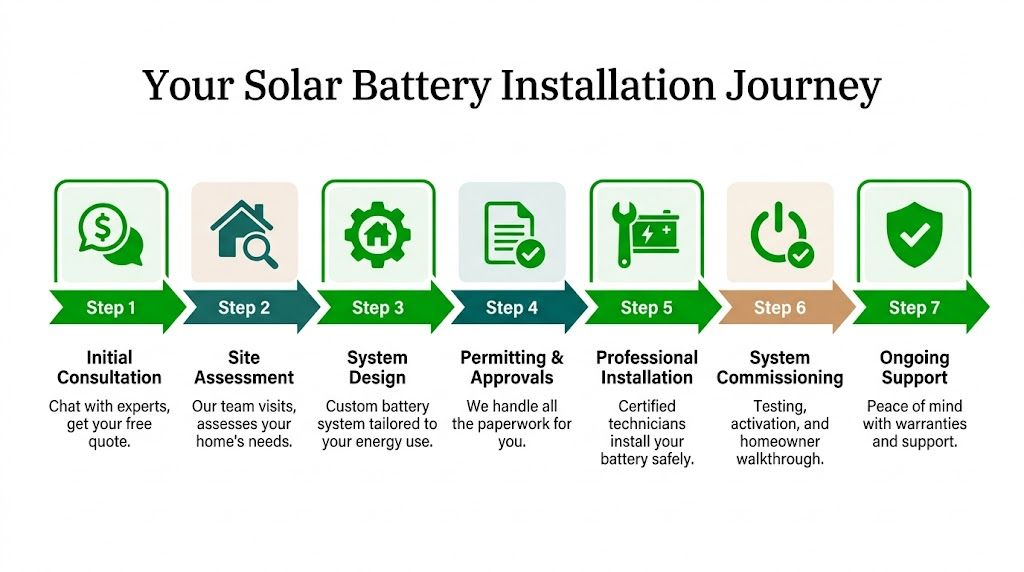
A professional battery job follows a clear sequence. Each step affects the next one, so early shortcuts tend to show up later as nuisance trips, weak backup performance, poor monitoring, awkward cable runs, or compliance problems.
Consultation and site assessment
The first visit is not just a measure-up. It is where the installer works out whether your home can support the battery setup you want, and what has to change to make it work properly.
That means checking the switchboard, existing solar equipment, inverter compatibility, wall construction, cable paths, ventilation, clearances, and access for service later. Battery placement matters for more than appearance. A neat spot on the side wall can still be the wrong spot if it creates heat issues, fails clearance rules, or makes future maintenance harder.
This stage also tests expectations against reality. If you want whole-home backup, the installer should explain whether your current board and inverter arrangement can support that, or whether a backed-up essential loads circuit is the practical option. Good installers say that early, before the quote is accepted.
Proposal and approvals
A proper proposal should read like a plan, not a product flyer.
It should spell out the battery model, how it will integrate with the existing solar system, what backup circuits are included, whether switchboard upgrades are required, how monitoring will work, and what assumptions the design relies on. If those details are vague, the risk usually lands on the homeowner later.
Approvals matter too. Grid applications, product eligibility, and network rules are easy to overlook until they delay the job. Installers with disciplined processes usually manage this behind the scenes, which is exactly how it should feel from your side.
Before signing, it helps to review what quality solar installations should include. Good workmanship shows up in the planning, not just in the finished photos.
A tidy quote helps. A tidy process matters more.
Installation day on site
On the day itself, the best crews are predictable. They arrive with the right gear, isolate safely, confirm the final equipment positions, and plan cable routes before the first hole is drilled.
Battery installation is electrical work with higher consequences than standard appliance replacement. The job has to comply with Australian battery installation rules, including battery clearances, protection methods, isolation, labelling, and shutdown procedures, as noted earlier in the article. Those details are what separate a professional install from one that only looks neat from a distance.
The technical work usually includes:
- Mounting the battery correctly: The wall or floor location must suit the battery weight, service access, and safety clearances.
- Running and protecting cabling: Cable size, conduit protection, routing, and termination quality all affect safety and long-term reliability.
- Integrating the inverter and backup hardware: Settings have to match the design, or the battery may charge, discharge, or export at the wrong times.
- Labelling and isolation: Clear labels and shutdown points are there for you, future electricians, and emergency responders.
A lot of poor jobs hide in small details. Crooked conduit is annoying. Incorrect settings are worse. They can leave a battery underused, over-cycling, or unable to respond properly during an outage.
Commissioning and handover
The job is only complete once the system has been commissioned properly.
That means testing communication between the inverter and battery, confirming the monitoring platform is live, checking charge and discharge behaviour, and verifying backup operation if backup is part of the design. If your home has an essential-loads circuit, the installer should show you exactly which circuits stay on and which ones drop out during a blackout.
Homeowners should leave handover with five things:
- The app installed and connected
- A clear explanation of normal daily battery behaviour
- A simple blackout demonstration or explanation
- Shutdown and restart instructions
- Warranty paperwork and one clear support contact
If handover feels rushed, questions tend to pile up later. That is usually when people start to realise they bought hardware, but not a well-managed installation service.
Aftercare is part of the install
A battery system needs support after the crew leaves. Monitoring alerts, firmware updates, seasonal performance questions, and warranty coordination are all part of ownership.
The best installers plan for that from day one. Homeowners should know who to call, what support is included, and whether the company that sold the system is also responsible for service. That sounds basic, but it prevents a lot of frustration when something small needs attention.
Good aftercare is usually quiet. Clear records. Fast answers. No confusion about responsibility. That consistency is what makes the whole supply-and-install process feel professional months after the installation is finished.
Understanding Long-Term Value Warranties and Maintenance
Most homeowners spend a lot of time comparing battery size and not enough time reading the warranty properly. That’s understandable. Capacity is easy to market. Warranty language is not. But long-term value lives in the fine print.
The first thing to understand is that all batteries degrade over time. That isn’t a defect. It’s normal battery behaviour. The useful question is how gradually that happens, what the warranty promises at the end of the warranty period, and whether the battery is likely to still match your household needs years from now.
What degradation actually means
The verified data notes that lithium-ion battery capacity typically degrades by 0.5 to 0.8% annually under Australian climate conditions, and that a quality battery usually comes with a 10-year warranty, according to the cited overview on solar-plus ownership considerations.
In practical terms, that means you shouldn’t expect year-one performance forever. A battery that feels generous in the first few years may feel tighter later if your household demand grows. That doesn’t make it a bad purchase. It means the original sizing decision should account for the long game.
How to read a battery warranty properly
A useful warranty review goes beyond the headline term. Look for these items:
- Capacity retention clause: This is the part that matters most. It tells you what level of usable capacity the manufacturer is prepared to stand behind by the end of the warranty period.
- Cycle or throughput limits: Some warranties are linked not only to years, but also to how much energy the battery processes over time.
- Installation conditions: Warranty support often depends on compliant installation and approved product pairing.
- Environmental limits: Heat, ventilation, and location can affect both performance and warranty validity.
You also want to know who helps if there’s a fault. Some homeowners assume the manufacturer handles everything directly. In reality, the installer often plays a major role in diagnosis, documentation, and replacement coordination.
A consumer-protection framework matters here too. If you want to understand the standards that shape transparent quoting, documentation, and customer protections, review the New Energy Tech Consumer Code overview.
Warranty mindset: Don’t ask only, “How long is the warranty?” Ask, “What exactly is being guaranteed at the end of it?”
Maintenance is light, but monitoring matters
Modern home batteries don’t need heavy physical maintenance. There’s usually no routine topping up or frequent manual servicing like older battery systems demanded. But low-maintenance doesn’t mean no attention.
Homeowners should check the monitoring app from time to time and look for unusual behaviour. If the battery stops charging as expected, discharges oddly, or loses communication with the inverter, it’s worth getting that investigated early. Small issues are easier to fix before they turn into long gaps in performance.
Long-term value also means accepting one uncomfortable truth. Battery replacement is a future ownership consideration. That’s why brand durability, support quality, and installer competence matter so much at the start. The cheapest-looking path on day one can become the most expensive path over the full life of the system.
Navigating Solar Battery Incentives in NSW
Incentives matter, but they shouldn’t drive the whole decision. The right order is this: first make sure the battery suits the house, then check which support programs apply. A poor system with an incentive attached is still a poor system.
NSW homeowners will usually come across two broad kinds of support. One is state-based assistance, which may include battery-related programs tied to eligibility rules. The other is the wider federal framework around renewable energy and compliant installation. Both can affect timing, paperwork, and what products or installers qualify.
Where many homeowners go wrong
The common mistake is assuming every battery offer is interchangeable. It isn’t. Incentive rules can depend on property type, installer accreditation, approved products, and how the system is configured. That’s why a reputable installer should explain the process before you commit, not after contracts are signed.
Another mistake is focusing only on the incentive headline and missing the operational fit. A battery should still make sense for your load profile, solar generation, and blackout priorities.
A practical way to approach incentives
Use this sequence when you’re comparing options:
- Confirm your goals first: Decide whether your priority is self-consumption, backup, or a mix of both.
- Check current NSW eligibility rules: Program settings can change, so always verify the latest conditions before relying on them.
- Ask who handles the paperwork: Some installers manage the process cleanly. Others leave most of it to the homeowner.
- Make compliance part of the conversation: Incentives and eligibility usually depend on correct product selection and proper installation documentation.
For NSW-specific updates and program context, this guide on the NSW battery rebate and what homeowners need to know is a useful starting point.
The best use of incentives is simple. They should improve the timing of a sound decision, not talk you into a rushed one.
How to Choose a Reliable Supply and Install Partner
A battery system can be excellent on paper and disappointing in practice if the installer is weak. That’s why the installer is not a minor detail in solar battery supply and install. The installer is the delivery mechanism for every promise in the quote.
Homeowners often compare brands first. In the field, the smarter order is usually installer first, system second. A good installer can steer you away from a poor fit. A poor installer can ruin a good product.

Questions worth asking before you sign
Don’t ask only what brand they sell. Ask how they work.
- Who installs the system? If the company uses subcontractors, ask who manages quality control and service follow-up.
- Who holds the electrical responsibility? Battery work should sit under properly licensed electrical supervision.
- What happens if the switchboard needs changes? A real installer will discuss this before the job, not spring it on you mid-install.
- How is backup configured? Ask which circuits will stay live and what won’t.
- Who supports the warranty claim? You want one clear path for help.
A good company should answer those questions without getting defensive.
Signs of a professional operation
A reliable installer usually leaves a pattern you can spot. They ask detailed questions. They inspect the site properly. Their quote matches the physical realities of the property. They don’t overpromise blackout capability without discussing load management.
Their process is usually organised as well. Many quality electrical businesses now rely on systems that keep scope, revisions, and approvals clear. If you’re curious how mature electrical companies structure quoting and handover, tools like efficient quoting software for electricians give a useful glimpse into how disciplined operations reduce mistakes before installation even begins.
Red flags that deserve caution
Some warning signs are obvious. Others are subtle.
| Red flag | Why it matters |
|---|---|
| High-pressure sales | Good battery design needs clear decisions, not rushed signatures |
| No proper site assessment | Remote-only quoting can miss switchboard, cable, and mounting issues |
| Vague backup claims | “Whole-home backup” means little unless the load plan is explained |
| No clear service path | Support confusion becomes painful when faults appear later |
| Brand-first, home-second advice | Good design starts with your usage, not warehouse stock |
If the sales process feels faster than the engineering, slow the conversation down.
What works and what doesn’t
What works is transparency. Clear exclusions. Straight answers about compatibility. Honest discussion about whether your existing solar can be retrofitted cleanly or should be redesigned.
What doesn’t work is treating batteries like a standard add-on. They’re not. They interact with the inverter, the switchboard, the home’s usage pattern, and the grid connection. Any installer who talks only about the battery cabinet and not the rest of the electrical ecosystem is skipping the hard part.
The best hiring decision usually comes from a simple principle. Choose the company that makes the project easier to understand, not the one that makes it sound effortless. Battery projects have real trade-offs. The installer you want is the one who can explain them plainly and still deliver a tidy, compliant result.
Frequently Asked Questions About Solar Batteries
Can a solar battery take me fully off grid
Sometimes, but that’s not the usual goal for suburban homes. Most homeowners are better served by reducing reliance on the grid and keeping essential loads powered when needed. Full off-grid design needs much more careful planning around seasonal solar production and household demand.
What happens during a blackout
That depends on whether the system includes backup capability and how it has been wired. Some batteries only optimise energy use. Others can power selected circuits during an outage. The handover should make this very clear.
How long does a battery take to charge
It depends on your solar production, battery size, household consumption during the day, and system settings. On sunny days with low daytime use, charging is much faster. On cloudy days or in homes with heavy daytime loads, it takes longer.
Can I add a battery to any existing solar system
Not always. Some systems retrofit well with AC-coupled storage. Others need inverter changes, switchboard work, or a broader redesign. Compatibility should always be checked before anyone promises a simple add-on.
If you’re ready to explore a battery system that fits your home properly, Interactive Solar can help you assess your usage, backup needs, and installation options with a practical, end-to-end approach.
Make Interactive Solar a preferred source in Google
One click tells Google to surface our articles more often in Top Stories, AI Overviews and AI Mode.